|
Supremes Biographies -
|

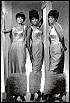
So much so that Mary Wilson, arguably the most overlooked of the three original Supremes, seized the public's attention with her version of their lives.
Scroll down for my reviews of both books!
Supremes Biographies -
Dreamgirl: My Life as a Supreme
  |
Mary Wilson is multitalented. If that wasn't obvious before, it will be after reading her writing project, which takes its name from the 1982 Broadway musical
(and now movie)
about a similar girl group and concentrates on the Ballard-Ross-Wilson triumvirate.
(I do the same in a less ambitious fashion here.)
She addresses much more than just her Supremes stardom. With mini-bios of key figures in her professional life (including Berry Gordy), recruitment tales, explanations of the music's development, and references to unethical company policies, Motown gets plenty of its own ink--negative and positive. As far as scope goes, the author aims pretty high.
There are a few factual flubs (e.g., Pip "William Knight"--does she mean Gladys's brother Merald Knight or cousin William Guest?). So backup research might be in order.
Far bigger occasions sweep aside those nitpicks. Wilson describes numerous showbiz meetings, performances, and trips, highlighting intriguing personal moments along the way. Photos document Supremes-stamped poses, spontaneity, and destinations on the road.
Through it all, Wilson's down-to-earth depiction of fame keeps that fantasy world from overwhelming her readers. It feels "there," not "here," but her storytelling skills keep those scenes sparking.
Speaking of whom, Mary Wilson gives great tribute to Ballard's phenomenal talent, personality, and flawed humanity by revealing her as she once was, later became, and ended up. I suspect it's something Wilson really wanted to get off her chest all those years.
Her other possible aim for the book? To slam Diana Ross.
Or as the author puts it, to share the "true story." Not "to expose or indict anyone" at all.
I tend not to sympathize with Ross, so I'm inclined to side with Wilson. That said, I don't always understand the "upsetting" nature of several of their interactions. Some of young Diane's teasing seems innocent to me. Wilson leaves the justifications for a few complaints unclear.
She cites other instances of a competitive, flirtatious, and hostile Ross that impress me with their stinging precision. Wilson is psychologically astute about the Supremes' interrelations and knows it. Still, her certainty about other people's motives and mindsets is kind of like answering the question, "How do you know...?" by saying smugly, "I just know."
Fortunately, Mary Wilson is very self-aware. A peacekeeping "fence-sitter," she calls herself, and characterizes as a weakness.
Despite all these nuances and layers, the author's narrative is so smooth that hardly any linguistic quirks come to the fore. Readers can lose themselves in the substance, and the book is definitely rich in that!
A timeline of appearances and recordings, a discography, and a videography sum up the seeable, listenable, and memorable Supremes through Diana Ross's time.
What about everyone from Jean Terrell on?
That's what the follow-up book is for!
Supremes Biographies -
Supreme Faith: Someday We'll Be Together

The dreamgirl writes on. But this "conclusion" to the first book is not as candy-coated as that persona sounds...nor as gossamer as this bio's title suggests.
Faith is the more eye-opening of the two Supremes biographies. Wilson begins with guns blazing against Diana Ross, Motown, and its founder. Her anti-Motown rhetoric is quite aggressive here, and she paints the scenario as "me against them." Berry Gordy's conflicting offenses--overbearing control and infuriating indifference--leave her suspicious of his kinder gestures.
All this Gordy-hate benefits Ross. To a degree, Wilson now sees her Supremes sister's monstrous side as Motown's creation. Both women support each other's solo efforts, and one get-together even earns the adjective "wonderful." It's nice--nothing dramatic or evocative, just nice. :)
The later Supremes members--including Jean Terrell, Lynda Laurence, and Scherrie Payne--get individual outlines, but Wilson's criticisms temper the flattery of such attention.
She's no angel herself. In this bio, Mary Wilson dwells on her many personal indulgences, from parties to drugs to affairs. At the hands of an abusive husband, though, she's a true victim of external forces.
As in the previous book, she offers insights about her own intentions, emotions, and circumstances that are as thorough as her observations abroad or of other people.
Unlike the earlier biography, Wilson's way with words emerges in phrases like "glitz plus glamour equaled white equaled phony" and cynical analogies about Gordy or marriage.
Photos? Check. Discography of the '70s Supremes and solo Mary? Check. Lists of fan clubs and undervalued colleagues (designers, Wilson's backup singers, et al) round out the usual bonus features.
Between both Supremes biographies, this one is more confidently written and, I think, the better book. Do you care enough about those Motown artists to stick with them as their fairy-tale fortunes disintegrate? If so, then this thornier journey is worth it.
Don't stop with these Supremes biographies! See reviews of more Motown books starting on this page.